Showing posts with label neillsville. Show all posts

Tuesday, October 14, 2014

Fall Rides

Lyle on Sidewinder


I was drinking in the surroundings: air so crisp you could snap it with your fingers and greens in every lush shade imaginable offset by autumnal flashes of red and yellow.” Wendy Delsol

Fall is without a doubt the best time of year to ride. Spring is buggy, muddy and has a chill that I can never warm up to. Summer sticks with the bugs but replaces the cold with sweltering air you can barely breathe. Winter? Well, there is nothing really wrong with pedaling in snow, but it still doesn't quite hold up to Autumn.

In my racing days, fall signaled the end of the riding year, rolling in the final races of the season, concluding with the Chequamegon 40-the Christmas and New Years of the fat tire world. The workout season is over and it's time to “just ride.” That philosophy of non-training now carries me throughout the year and I can pedal to no strict regiment or because I have to. Okay, not quite true, I do “have to” ride in the fall. As Delsol writes, I so look forward to “drinking in the surroundings,” many times frantically not knowing what to do or where to go first. There are so many things pulling me in different directions, if only October were twelve weeks long. The black lab prances after work, convinced we'll be toting a shotgun chasing birds, the backpack waits to be slung on a shoulder and a tree stand impatiently expects my return. There are leaves to shuffle under foot as well and wildlife to photograph. But the mountain bike leaning in the corner is most anxious because I am. Those knobbie tires need to run over the carpet of yellow, orange and red in the woods, not always quite sure were the trail lies hidden beneath.
Yellow Carpet Ride


Eventually, each fall pursuit will get it's share of my time, but never enough and I feel the same way. Luckily for me, others concur and my bike is more than willing to share some singletrack with company. Biker friends from Madison arrived at their favorite trail (and mine) on what could only be described as a perfect autumn weekend. Trees in full color, that “crisp” air surrounding us and the scent in the breeze that only waifs by when leaves tumble to the earth.

Like myself, Lyle, Kelsey and Kat had no interest in a discipled ride of heart rates and average miles per hour. We were turning pedals and rolling tires to just soak this season in at whatever pace necessary not to miss it. Favorite routes like Sidewinder and Wolf Run (at Levis Mound) were revisited, this time with so much more color and snap. Riding some in reverse of usual added a new dimension, nearly like discovering a brand new trail. Other mountain bikers had similar ideas and it was nice to meet here and there along the trail. “Remember this,” I thought to myself, as the bike carved corners and scattered popple and oak leaves behind. This season would soon be gone and homage must be paid by stopping frequently, taking a few pictures and breathing it all in.
Kelsey & Kat & Yellowjacket

Days like these pass quickly and too soon the bikes roll to a stop at the trailhead leaving me to wonder how much I missed out there. There is always more to take in. While my friends refueled and readied for another ride, the other fall interests tugged me away from taking another spin...reluctantly. More hours in a day? More days in this month? I can only dream, dream of just one more ride in this perfect time of year.
Sidewinder in Fall

Wild Ride


Saturday, December 21, 2013

The Snowy Owl “Invasion” of 2013


It seems the winter of 2013-2014 is starting with a bang-sub zero temps and a solid blanket of snow are leading us out the door with skis and tip ups in hand and fatbikes rolling on packed trails. In my case, I've headed out the door armed with a binoculars and long telephoto lens bayonetted onto my camera. Reports on ebird.com and in the news are reporting an invasion of Snowy owls across the state.

Although it's not entirely understood why we in Wisconsin (and other states) are treated to this arctic visitor, theories abound. Bust and boom populations of their preferred food, Lemmings, may drive the majestic birds south, in search of better hunting. Successful breeding may also lead to abundant adolescent birds being pushed south for new territory. No matter the reason, every few years, when the birds arrive, we have a wonderful opportunity to experience them. To non-birders, the regal white bird may be familiar as Harry Potters' pet owl Hedwig. And indeed, no other owl is quite as striking as the Snowy. Not entirely white, the bird has perfect camouflage for our Wisconsin winters. The often more observed juveniles, tend to have greater black or dark grey barring across the chest and head, while mature adult males are “cleaner” in coloration.

I can remember maybe seeing just one Snowy owl in the past, on a telephone pole near my parents home in Wausau. I do enjoy birding and photographing birds, so when the “snowy alarm” went off on facebook a few days ago nearby, I just had to make an attempt to see one again. Our local game warden, Adam Hanna, had observed a snowy along a county hi-way north of Neillsville and recorded a fuzzy video of it from his truck. The following morning a good friend asked if I'd like to go in pursuit, cameras in hand, for the birds generally will stay on one area if food is abundant.

The location was a bit of a drive fro us, so we scanned every tree, every power pole and fence post on the odd chance another owl was in the area-a real possibility. As we slowly made our way within a few miles of Adam's sighting, I happened to glance out the side window and amazingly,  a Snowy was flying right at us! Without thinking, my thumb hit the power button on the camera in my lap, I swung the lens up and started firing through the glass window and the bird closed in. It gently flew over the car and lit in a corn stubble field a hundred yards away. From our vantage point, we could just make out the grey and white blob resting on the snow. Both of us kept shooting, but with a paultry 300mm lens, chances of having a good image were marginal at best. The owl seemed to be in no hurry and after observing “him” for sometime, we decided to continue our search in case this was a different owl than was seen the previous day 3 or 4 miles away.

Nothing else turned up and we returned to the corn field where besides glancing our direction from time to time, the bird seemed content where he was. We hoped to get closer shots, but also didn't want to disturb him in anyway so for this day, we would be happy with the extremely lucky images captured on my camera. We did return the following day, but no luck-there are a lot of woodlots between these one mile county “blocks” so he could have been about anywhere or moved on to better habitat. If that's the case, perhaps someone else will have this fortunate opportunity to observe one of natures rare treats-if so, take every advantage of this invasion! More sightings here: ebird


Friday, December 13, 2013

Sturtz Creative Lighting


Creative
adjective
: having or showing an ability to make new things or think of new ideas
: using the ability to make or think of new things : involving the process by which new ideas, stories, etc., are created

I can think of no better word to define good friend Rick Sturtz and what must go on when the synapses are firing inside his mind.   He invented “thinking outside the box.”  He’s one of those people who has a canny ability to see things different (taking nothing from Steve Jobs here) no matter what his endeavor.  

Over the years, and especially since he and wife Toni moved “down the road” as country neighbors,  a highlight of my day would be stopping by their home for a visit.  I’d be pretty much guaranteed the best cup of coffee in the world and some stimulating conversation, ranging from the beauty of their restored prairie and farmstead, to living life in retirement (not me yet) to his latest projects.   No one could be more excited to share things he’s working on than Rick. 

“So what’s with the lights?” I’d asked recently. Word on the street (dusty dirt and gravel roads of the Town of Hewett anyway) is he’d started a company tackling the world of buying, refurbishing and selling old industrial lights.  Now Ricks talent as an artist in the woodworking field is well known, where he creates magical pieces of furniture from stockpiles of amazing wood.  Rick is a true wood connoisseur, but old lights? 

Rick always has had a menagerie of things he finds and repurposes-again, thinking outside the box.  I’d seen some of his lights in their remodeled farmhouse and a local supper club and they are very interesting pieces.  I love them.  It seems now he’s jumped in with both feet.  I was dazzled by the variety of lights hung from every nook and cranny of his workshop, even spilling out the door.   He’d wisely decided that instead of going the ebay route, a more professional tactic would be creating a web page with examples of his best inventory.  By chance I was invited to just hang out and monitor Rick and son Eric’s progress in photographing these intriguing pieces.  Of course, my camera was in hand and I could photograph the photographers, plus ramble around the shop and record anything else of interest-no shortage there.

What follows are some of my favorites from the session and for me on a personal note, it just felt good to press the shutter again and again while trying to “see” pictures.  In the background, Eric and Rick experimented and tried new lighting techniques in their shots, while attempting to stay consistent in the images for the web page.  I rather enjoyed their banter, along with the oldies Christmas music in the background which we were constantly quizzed on.   It didn’t take long for me to forget these were once (and would be again) purposeful items as I just enjoyed them as shapes, forms and abstractions casting shadows within the confines of the shop.


Monday, July 8, 2013

Wolf Flight

Pre-Flight Check

Pilots take no special joy in walking. Pilots like flying.
Neil Armstrong

Probably no quote better describes Beverly Paulan,  a Lead Pilot for the Bureau of Forestry Protection in the Wisconsin Department of Natural Resources in Eau Claire.  She does spend her share of time on the ground-perhaps during Karner Blue Butterfly habitat surveys or volunteer hours tracking bats, but the sky is her home to be sure.

The opportunity to join her on a wolf survey flight was one I just couldn’t pass up as I’ve taken a great interest in them over the years-especially several radio collared ones in my home area recently.  I’d hoped to do a winter flight at some point for the chance to photograph them from the air, but a summer flight would prove very rewarding as well.  

Before joining the Wisconsin DNR as a pilot in 2010, Beverly was a full time flight instructor, charter pilot and also worked with cranes at “Operation Migration.”  As she told me, she’s “loved flying as far back as I can remember.”  It took awhile, but landing the DNR job as a pilot, (pun intended)with her love of wildlife and the outdoors, was a perfect fit.  “I have the best office in the world!” she happily shared.  Besides wolf radio tracking from the air, she and fellow Eau Claire pilot Leo Bunderson, also fly swan, wintering duck and eagle surveys, Whooping crane studies, Otter counts, fire protection and monitoring Gypsy Moth spraying. 

Some of the flights, especially the bird surveys, can be “challenging” to say the least.  Low altitudes, sometimes just 80 feet above the deck, are required of pilots in order to count nesting birds, eggs or the progress of hatched eaglets, “colts” (cranes) or cygnets.  “Be careful, because the ground can come up and smite thee!” is a serious word of advice from her father.  Besides the normal array of radio and cell towers, it’s becoming more common to come upon portable, non-licensed towers popping up 100’ which can pose a real hazard to these fliers.  

Although Whooping cranes are fitted with radio collars, they do not have mortality signals like wolves do (or other collared mammals), so visual confirmation is needed when monitoring them-requiring a balance between getting low and close and not causing any change in the birds demeanor, something very important to Paulan.  “Whether a wolf or crane, I don’t want to see any change of their normal behavior when observing them-that’s just my principle when flying close.”

On our flight, we left the Chippewa Valley Regional Airport, which is the base of operations for DNR flights in this sector of the state.  The goal was to pinpoint the locations of 6 wolves that were transmitting radio signals and record their movements from earlier flights.  Especially important were checking on two wolves collared the previous weekend to be sure they were doing okay.  Every collar is assigned a frequency and every wolf designated a number (and sometimes a nickname by researchers).  “I know I shouldn’t get attached to an animal, but you do.”  Beverly mentioned.  “An animal you’ve kept tabs on for a long time or one that went off air and returned much later can cause a little celebration in the cockpit!” 

One such animal for me was “Seca” or #795, a wolf trapped and collared last year when I joined a monitoring team and had the privilege to photograph.  Since his location was near my home, a biologist friend kept me apprised of how he was doing and his movements in the area.  We were all pleased he appeared to be doing well and came through the inaugural wolf hunting season this past winter.  Unfortunately, earlier this summer, Seca “went off the air” and no mortality signal was received.   Weekly flights turned up no further sign of him and Paulan shared that most likely he was the victim of “lead poisoning” or illegal shooting.   The animal is poached and the expensive collar quickly destroyed, leaving valuable scientific research unfinished.  “Some areas of the state are particularly difficult to keep a wolf alive,” a hint of frustration in her voice.  Paulan also shared that studies are showing there is more suitable habitat for wolves than previously thought and numbers seem to be stable.  Packs tend to be smaller as is their territory and at times overlap, but they seem more tolerant than wolves in other parts of the country.  Wolf surveys, hunt harvests, car kills and other causes of death are used to determine populations and goals.  What’s not known is how many animals, like Seca, just “disappear.”

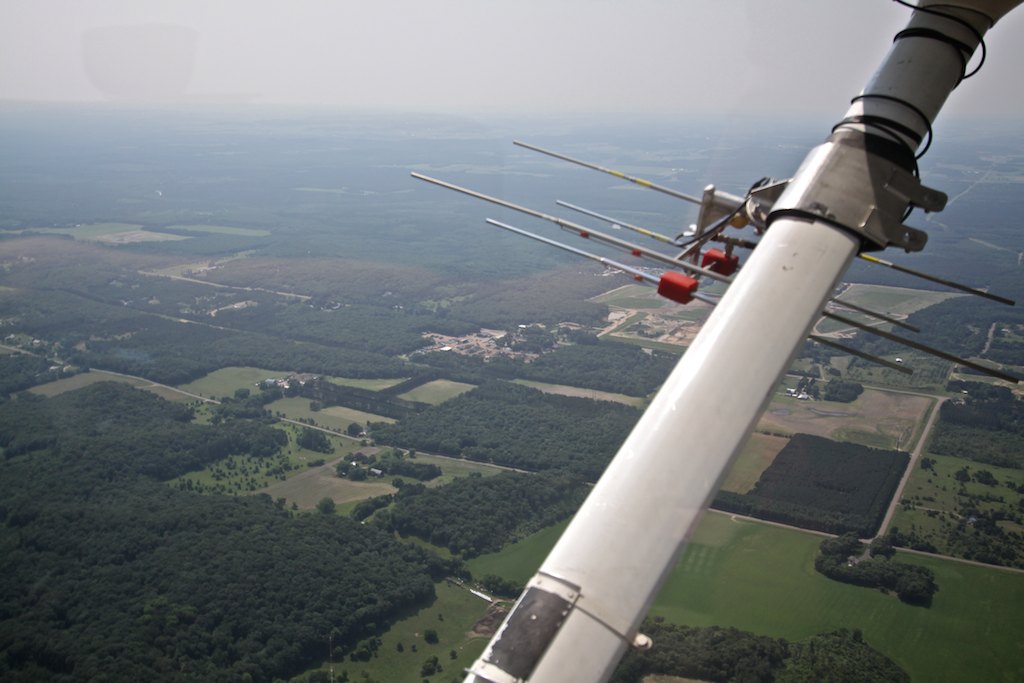
As our flight headed east, the first wolfs’ transmission was quickly picked up very near its previous GPS position.  Each wolf (and crane or other surveyed animal) have a GPS waypoint from their last known fix, making it easier to quickly find a signal.  It’s pretty amazing to see Beverly fly the plane, flip switches between two antennas on either wing, cradle the transceiver adjusting squelch (sensitivity to a signal), punch in a new GPS point and hand write a note in her observation folder….almost all at the same time.  Dropping altitude and circling tighter usually was rewarded with a comment like “Yep-he’s right under us.” Or “somewhere in that patch of pine.”  Slight nudges of the pedals or a touch to the yoke, set us on course to the next wolf.

If it’s only a weak transmission-perhaps from an old collar and batteries, we’d ascent higher to try and catch the cone-like signal to narrow in on the location.  Dropping down low would then pinpoint the exact spot within a hundred yards or closer.  I’d not flown in such a small craft like Paulan’s  Cessna 172 but tolerated the ever tightening steeply banked turns required to hone in on a fix-kinda fun, actually!

Flying at just 3000 feet above the landscape was such a great perspective-particularly since part of our flight was over county forest I know well.  Seeing trails, forest roads and wetlands from above kept my head glued to the window, camera at the ready.  Recording one wolf location after another, we continued south east and made a slight detour to check on a whooping crane occupying a nest.  The bright white speck was easy to pick out from the surrounding lush green marsh, and it’s posture told Beverly that the eggs were not hatched as of yet.  Both male and females will help incubate the eggs she added.  Trying to photograph from the plane proved to be difficult- a lot of movement and we did stand off a bit so as not to disturb the nest.

Two wolves occupy territory within the Air National Guard’s Hardwood bombing range and surrounding wildlife area south of Babcock, and yes, animals have been lost here because of military training.  Beverly radioed ahead to Camp Douglas to confirm the range was not” hot” (open for training) and safe to enter.  It was rather odd to see tanks, containers and aircraft randomly scattered in the thick forest below in various stages of destruction.  Apparently, it still can be home for wildlife, as the two wolves here were found and we headed back out. I wished inside, they’d perhaps move to a safer habitat. 

The newly collared wolves were pinpointed and I perceived some relief from Paulan, “It’s always comforting to get that first signal after collaring, a strong signal tells us everything is working well.”  I was surprised how far one of them had moved-maybe 4 or 5 miles from the capture site.  “Actually, I’m happy to see them on the move like that-it tells us they are healthy and doing well.” commented Paulan.  Sometimes successive flight observations can also help gauge how they are recovering from an injury, for instance.  One subject, who had suffered leg trauma, visibly could not use that limb at first.  Each week, Paulan observed him recover slowly, a limp, then gradually full use of leg.  It also told researchers that he was with a supportive pack or he would not have survived.

Our return flight took us over the Sandhill Wildlife Area, where we had a chance to observe bison settling down in their sand wallows-the giant animals easy to pick out below.  Small flowages I’d duck hunted in many years past were nearby and I recognized some here within Sandhill.  It was amazing how quickly you can get from point A to point B in this small plane, yet we were only traveling at 90 or so knots.  Landscapes take on a whole new look, the topography isn’t always obvious.  I’d pick out features like the Black River, Lake Arbutus or Lake Eau Claire to get my bearings-Beverly used major road ways.  Near Augusta, one easy landmark contrasting from the surrounding Amish farms was a massive frac sand mine with a mile plus conveyor moving sand to a plant and rail road spur.  From the air the huge holding ponds nestled right next to small farms and cropland could easily be distinguished.  How the influx of these mines must have changed the living environment here.

After gently setting down back in Eau Claire, we had a chance to review parts of the flight, their profession as pilots and some like minded discussion on wide ranging topics, from hunting to public service careers.  What became clear is that for Paulan, being a DNR pilot is not so much a job, but rather a calling-for she is just as passionate about the environment, outdoors and wildlife and their well being as she is about flying.  Although Armstrong said-  pilots like flying,” and Paulan does, she also takes very seriously why she is in the air and what her work provides for biologists, scientists and anyone who loves Wisconsin’s outdoors.


Tuesday, October 9, 2012

Faces of the Parade

It's become another yearly thing, photographing the Neillsville Homecoming parade.....  Just like the first day of school, I like to have the camera at the ready for what I know will be some great photographic opportunities-as I like to say, a "target rich environment."   The expressions of the kids, happy to be at the parade, maybe happier to be out of school early, are usually priceless.  Walking down the street from school, with camera and long lens in hand, I'm everyones best friend it seems.  There are plenty of "smile, say cheese" shots (which usually are the worst) but my favorites are the casual and documentary style ones of the spectators watching the parade in anticipation.  Sometimes along the way, I manage some nice portraits as well....surprises in a way, but ones I like because I know just about every student sitting on the curb. 

Of course, my best are always the images that I feel catch the personality of the person, and even though most of them are young, by now, a few years in my classroom, I see that personality come out frequently.  Great kids, and as always, fun for me to photograph.


Smith: Tracking surveys remain critical part of DNR's gray wolf population estimate in Wisconsin

  Smith: Tracking surveys remain critical part of DNR's gray wolf population estimate in Wisconsin Tracking surveys by DN...