Monday, July 22, 2013

The Dog Corner

 
-->
It was time.  A long sought after rainy afternoon- a rare day this summer, cool and wet “forced” me into the garage for a 3 hour date with organizing and cleaning the man cave.  My garage has racks for bikes, space for gardening, a corner for straps, bungies and extension cords and plenty of car and truck oil to be recycled. Rearranging the location of various items proceeded, screws and nails of various sized snuggled into jars, bike and auto cleaning supplies lined up by cleaning process. But there is also the “dog corner.”  It was time. 

In THAT corner were the collars of dogs I’ve loved.  The township and rabies metal tags long since silent hanging on a hook.  Hanging there quietly since the day I needed to say good bye to each one of them.  Max, my first Golden, back in 1987 was maybe the toughest.  My first dog not under my parents roof, a retriever of my very own.  No formal training as in hunting, but he did well and I remember vividly his final retrieve on my dads land late in a November-a grouse I’d miraculously shot at …and hit, and he had little trouble finding.  I remember his slow trot back, wings still flapping in his muzzle, and knowing his cancer already sapping every stride back to me.  Weeks later, we needed to say good bye.

  Dewey, the “recovery” dog, a black lab from a family in Marshfield, the first dog the children grew up with, although they very young at the time.  He developed from a mere family dog to a suitable hunter as well.  He learned to sniff out timber doodles and "partridge" with the best of them in his younger years, but later, sadly, the report of a gun or rumble of thunder, sent him scurrying to safer locations.  He was well loved, even with the premature graying snout and white hair between his toes. 

A puppy arrived before Dewey left us- Ruger, a fur ball of a golden retriever puppy.  The two dogs played, and more than tolerated each other, eventually becoming buddies and comrades in cahoots.  It house became a bit quieter after the sad farewell to salt and pepper  “Dew”…another victim of the all too-present cancers in large retrieving breeds.

 Ruger became THE dog for the kids-fuzzy and full of life, he too picked up the hunting bug with ease.  Maybe the best of our ‘pups’ as a game dog, he could tarry thru the thickest cover-just knowing a bird was in there-and always confident was his retrieving- sniff ‘em out and bring them back….abet, a touch unwillingly at times.  In water “The Ruugs” was great-he’s swim like an otter and if he had his way, would stay dripping and wet-dog-smelling whenever he could.    Nothing tugged at our hears like when we found out he too had a cancer and would have few months to live that winter. 

Like before, another dog found her way here-seemingly the right thing to do.  A second dog for companionship, maybe extending Rugers life.  Molly was already full grown, but had spent her life in a breeding kennel.  Her pedigree and natural instincts were top notch and it was obvious she would be a keeper.  Ruger and Molly hung out for a half a year until our daily snowshoe hikes began to take it’s toll on the elder dog.  My heart ached when I had to encourage him to keep trudging thru the snow-something he’d lept at before, just to make it back home.  When the time came, we knew.  His collar hung up by the rest in the garage on an old rusty nail.  Tags dangling motionless.

So this day, it was time.  Molly vigorously wagging her tail to go out and do anything….sadly realizing I was just cleaning, not heading to the lake to retrieve with her.  I realized it was time to unhook all those collars, slide the rusty scratched up tags off them and get them washed up.  Maybe a good cleaning would be the acceptable thing-not for Molly, she would never wear them, they weren’t hers.  Just to have them clean and maybe on a new hook in the garage in the “dog corner.” That would just be the right thing to do…..it was time.

Monday, July 15, 2013

Paddling Oxbo Pond


“Oxbow: A U-shaped body of water formed when a wide meander from the main stem of a river is cut off to create a lake.”

I’ve always been a wanna-be paddler- specifically in a kayak .  I’ve had chances to dip a paddle from time to time, years separating those excursions it seems, but enough to whet my appetite.  I don’t own a boat, but a few friends do, and when asked, I’ll gladly join them to explore some outdoors 6 inches above the waterline.

“Oxbo Pond” is located in the 68,000 acre Black River Falls State Forest, 11 miles east and north of Black River Falls off State hwy. 54 on South Cemetery Road.  Good friend Tom Krotzman suggested  this quiet, off the beaten path waterway to survey-a good choice for a reserved paddle as I discovered.  Oxbo Pond is a day use area, hidden below the mostly flat surrounding jack pine forest.  Facilities include parking and a few scattered picnic tables.  The “lake” was once part of Robinson Creek, which noisily flows nearby, separated by a thin strip of land.  The shoreline is low and easy to slip the boats into to begin our trip.  Although it’s a small body of water, the meandering ribbon seems to open up a new door around every corner.  I was reminded of Thoreau’s quote: “Wherever there is a channel for water, there is a road for the canoe.” Some of the shoreline is beautiful floating bogs, sprinkled with blue water Iris and other wetland plants.  The next bend in the shore reveals towering sand banks and evidence of beaver working hard to slide trees down into the water for a winter cache.  Towering, hundred year old white pine, once carpeting this part of the state, line another shore.  Tom and I marvel at the size of these trees and remark how majestic the forest must have looked at one time prior to the lumbering years.  The remnants of an eagle nest lay strewn beneath one, no doubt blown down during a strong windstorm-we see the platform of sturdy limbs 90 feet above us as we slide by in the water.

The pond constantly changes directions and we make no effort to reach the next bend quickly, but rather just pull on a paddle from time to time and drift slowly by the shore, water silently lapping against the hull.  The cool surface gradually gives up a thin veil of steam as the sun begins to warm, on track to produce another humid day after we leave.  I busy myself with the camera, trying to “see” pictures as I float by things I don’t see everyday.  Tom seems more intent on just letting the nature come to him, very Zen-like as we drift along.

 Although this was once part of a river, the stream long ago changed it’s mind and it’s course and we too soon approach a dead end. I’m a bit wistful at reaching the turn around point, but expect to see things I’d missed as we reverse course.  We do. The sun has climbed higher and throws light a bit differently on the shore.  Signs of animals, who make their home above us on the bank and opposite in the wetland are everywhere, although on this day stay hidden save for many species of birds flitting around.  The water trail takes us back to our starting point, the widest part of the waterway, and we split up, encircling the bay in opposite directions, each exploring things we may have missed on the outbound paddle.

If there is magic on this planet, it is contained in water. -- Loren Eiseley

Oxbo Pond is a little gem, hidden away, and mostly unheard of, but worthy of exploring if in the area.  Jackson County, not only home to the state forest, but also an expansive county forest, has many other waterways to venture out on.  From what can be a big brandishing river like the Black to small still waters like Teal and Potters Flowages to lesser rivers and streams like Halls Creek and the East Fork of the Black River.  All seem to have a bit of that “magic” Eiseley speaks of.  For me, it was another chance to hear one of my favorite sounds, the serenity of quiet beads of water dripping off the paddle tips into cool water.


Monday, July 8, 2013

Wolf Flight

Pre-Flight Check

Pilots take no special joy in walking. Pilots like flying.
Neil Armstrong

Probably no quote better describes Beverly Paulan,  a Lead Pilot for the Bureau of Forestry Protection in the Wisconsin Department of Natural Resources in Eau Claire.  She does spend her share of time on the ground-perhaps during Karner Blue Butterfly habitat surveys or volunteer hours tracking bats, but the sky is her home to be sure.

The opportunity to join her on a wolf survey flight was one I just couldn’t pass up as I’ve taken a great interest in them over the years-especially several radio collared ones in my home area recently.  I’d hoped to do a winter flight at some point for the chance to photograph them from the air, but a summer flight would prove very rewarding as well.  

Before joining the Wisconsin DNR as a pilot in 2010, Beverly was a full time flight instructor, charter pilot and also worked with cranes at “Operation Migration.”  As she told me, she’s “loved flying as far back as I can remember.”  It took awhile, but landing the DNR job as a pilot, (pun intended)with her love of wildlife and the outdoors, was a perfect fit.  “I have the best office in the world!” she happily shared.  Besides wolf radio tracking from the air, she and fellow Eau Claire pilot Leo Bunderson, also fly swan, wintering duck and eagle surveys, Whooping crane studies, Otter counts, fire protection and monitoring Gypsy Moth spraying. 

Some of the flights, especially the bird surveys, can be “challenging” to say the least.  Low altitudes, sometimes just 80 feet above the deck, are required of pilots in order to count nesting birds, eggs or the progress of hatched eaglets, “colts” (cranes) or cygnets.  “Be careful, because the ground can come up and smite thee!” is a serious word of advice from her father.  Besides the normal array of radio and cell towers, it’s becoming more common to come upon portable, non-licensed towers popping up 100’ which can pose a real hazard to these fliers.  

Although Whooping cranes are fitted with radio collars, they do not have mortality signals like wolves do (or other collared mammals), so visual confirmation is needed when monitoring them-requiring a balance between getting low and close and not causing any change in the birds demeanor, something very important to Paulan.  “Whether a wolf or crane, I don’t want to see any change of their normal behavior when observing them-that’s just my principle when flying close.”

On our flight, we left the Chippewa Valley Regional Airport, which is the base of operations for DNR flights in this sector of the state.  The goal was to pinpoint the locations of 6 wolves that were transmitting radio signals and record their movements from earlier flights.  Especially important were checking on two wolves collared the previous weekend to be sure they were doing okay.  Every collar is assigned a frequency and every wolf designated a number (and sometimes a nickname by researchers).  “I know I shouldn’t get attached to an animal, but you do.”  Beverly mentioned.  “An animal you’ve kept tabs on for a long time or one that went off air and returned much later can cause a little celebration in the cockpit!” 

One such animal for me was “Seca” or #795, a wolf trapped and collared last year when I joined a monitoring team and had the privilege to photograph.  Since his location was near my home, a biologist friend kept me apprised of how he was doing and his movements in the area.  We were all pleased he appeared to be doing well and came through the inaugural wolf hunting season this past winter.  Unfortunately, earlier this summer, Seca “went off the air” and no mortality signal was received.   Weekly flights turned up no further sign of him and Paulan shared that most likely he was the victim of “lead poisoning” or illegal shooting.   The animal is poached and the expensive collar quickly destroyed, leaving valuable scientific research unfinished.  “Some areas of the state are particularly difficult to keep a wolf alive,” a hint of frustration in her voice.  Paulan also shared that studies are showing there is more suitable habitat for wolves than previously thought and numbers seem to be stable.  Packs tend to be smaller as is their territory and at times overlap, but they seem more tolerant than wolves in other parts of the country.  Wolf surveys, hunt harvests, car kills and other causes of death are used to determine populations and goals.  What’s not known is how many animals, like Seca, just “disappear.”

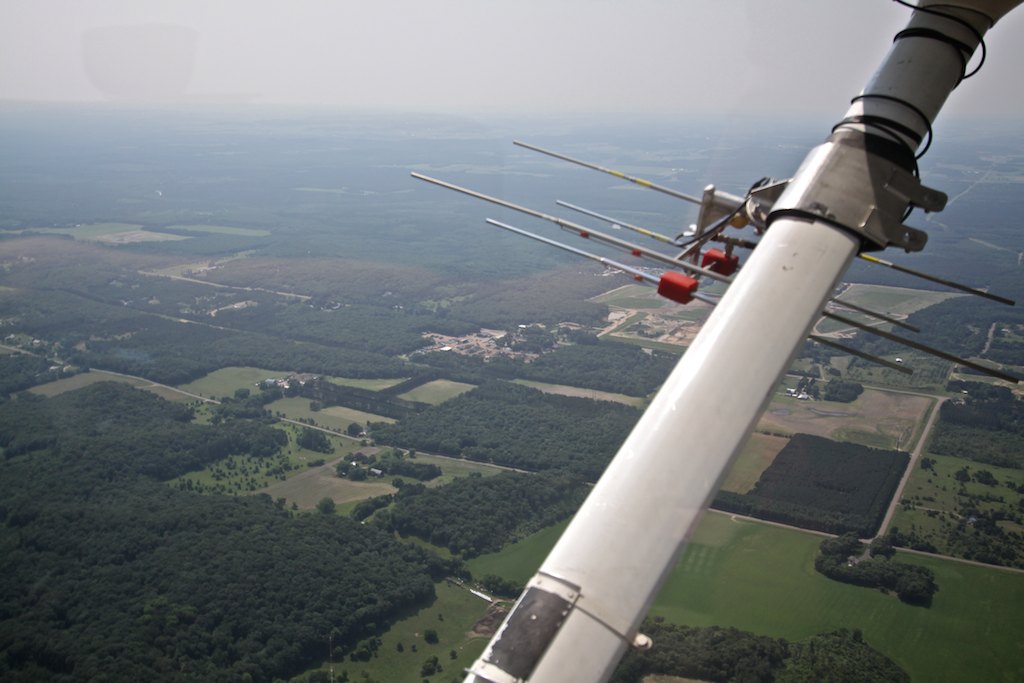
As our flight headed east, the first wolfs’ transmission was quickly picked up very near its previous GPS position.  Each wolf (and crane or other surveyed animal) have a GPS waypoint from their last known fix, making it easier to quickly find a signal.  It’s pretty amazing to see Beverly fly the plane, flip switches between two antennas on either wing, cradle the transceiver adjusting squelch (sensitivity to a signal), punch in a new GPS point and hand write a note in her observation folder….almost all at the same time.  Dropping altitude and circling tighter usually was rewarded with a comment like “Yep-he’s right under us.” Or “somewhere in that patch of pine.”  Slight nudges of the pedals or a touch to the yoke, set us on course to the next wolf.

If it’s only a weak transmission-perhaps from an old collar and batteries, we’d ascent higher to try and catch the cone-like signal to narrow in on the location.  Dropping down low would then pinpoint the exact spot within a hundred yards or closer.  I’d not flown in such a small craft like Paulan’s  Cessna 172 but tolerated the ever tightening steeply banked turns required to hone in on a fix-kinda fun, actually!

Flying at just 3000 feet above the landscape was such a great perspective-particularly since part of our flight was over county forest I know well.  Seeing trails, forest roads and wetlands from above kept my head glued to the window, camera at the ready.  Recording one wolf location after another, we continued south east and made a slight detour to check on a whooping crane occupying a nest.  The bright white speck was easy to pick out from the surrounding lush green marsh, and it’s posture told Beverly that the eggs were not hatched as of yet.  Both male and females will help incubate the eggs she added.  Trying to photograph from the plane proved to be difficult- a lot of movement and we did stand off a bit so as not to disturb the nest.

Two wolves occupy territory within the Air National Guard’s Hardwood bombing range and surrounding wildlife area south of Babcock, and yes, animals have been lost here because of military training.  Beverly radioed ahead to Camp Douglas to confirm the range was not” hot” (open for training) and safe to enter.  It was rather odd to see tanks, containers and aircraft randomly scattered in the thick forest below in various stages of destruction.  Apparently, it still can be home for wildlife, as the two wolves here were found and we headed back out. I wished inside, they’d perhaps move to a safer habitat. 

The newly collared wolves were pinpointed and I perceived some relief from Paulan, “It’s always comforting to get that first signal after collaring, a strong signal tells us everything is working well.”  I was surprised how far one of them had moved-maybe 4 or 5 miles from the capture site.  “Actually, I’m happy to see them on the move like that-it tells us they are healthy and doing well.” commented Paulan.  Sometimes successive flight observations can also help gauge how they are recovering from an injury, for instance.  One subject, who had suffered leg trauma, visibly could not use that limb at first.  Each week, Paulan observed him recover slowly, a limp, then gradually full use of leg.  It also told researchers that he was with a supportive pack or he would not have survived.

Our return flight took us over the Sandhill Wildlife Area, where we had a chance to observe bison settling down in their sand wallows-the giant animals easy to pick out below.  Small flowages I’d duck hunted in many years past were nearby and I recognized some here within Sandhill.  It was amazing how quickly you can get from point A to point B in this small plane, yet we were only traveling at 90 or so knots.  Landscapes take on a whole new look, the topography isn’t always obvious.  I’d pick out features like the Black River, Lake Arbutus or Lake Eau Claire to get my bearings-Beverly used major road ways.  Near Augusta, one easy landmark contrasting from the surrounding Amish farms was a massive frac sand mine with a mile plus conveyor moving sand to a plant and rail road spur.  From the air the huge holding ponds nestled right next to small farms and cropland could easily be distinguished.  How the influx of these mines must have changed the living environment here.

After gently setting down back in Eau Claire, we had a chance to review parts of the flight, their profession as pilots and some like minded discussion on wide ranging topics, from hunting to public service careers.  What became clear is that for Paulan, being a DNR pilot is not so much a job, but rather a calling-for she is just as passionate about the environment, outdoors and wildlife and their well being as she is about flying.  Although Armstrong said-  pilots like flying,” and Paulan does, she also takes very seriously why she is in the air and what her work provides for biologists, scientists and anyone who loves Wisconsin’s outdoors.


Sunday, June 2, 2013

MKE Cohos


 “If people concentrated on the really important things in life, there'd be a shortage of fishing poles.” - Doug Larson

“Bike or fish?  After a week of rain, storms and flash flooding, I decided the fatbike could stay in the stable and trails have a chance to dry out.  Singletrack would have to wait.  An invitation to ride the rollers on Lake Michigan in search of coho salmon just could not be turned down.  Long time friend Kris Davis and I met many years ago when we shared the same mountain bike trails.  While he still has a passion for bikes, the desire to pull up big fish from the depths seems to have become his calling in life.  “Captain” Kris had the good fortune to find a great boat a year or so ago-one capable of handling the deep waters of Superior and Lake Michigan.  Although he’d fished the Great Lakes in a smaller craft,  the Bayliner, loaded with fishing gear, (Kris began to collect in earnest) was perfect for the task and a beauty to fish from.

Raised on small lakes and small fish of northern Wisconsin, tackling immense bodies of deep water with tons of gear is a new thing for me.  I enjoy river fishing salmon on the east coast of Wisconsin in the fall, but it’s a whole other thing to be miles off shore at great depths coaxing fish to bite.  Luckily, Kris has the experience, knowledge and gear enough to take me under his wing from time to time to share his passion.

Not having a home slip on Lake Michigan, a trip to fish for Kris involves trailering  the 5000 pound boat 140+ miles from Loganville Wisconsin -no easy task, and then finding a suitable harbor and launch.  Trusting in his ability, we headed to Milwaukee, where Kris felt the coho fishing may be decent as water temps warmed.  The previous week in Kenosha, he and his angling kids limited out in a few hours.  He does his homework, scouting water temps off shore, checking fishing reports and finally, just jumping in and motoring out a mile or two, following his intuition.  It usually is spot on.

I’m a rookie, along for the ride for the most part and just nod in agreement as he talks about water depth, surface temps, wind direction, sun or clouds and the color of his latest fly and treble hood “coho candy” lure.  I have no idea what will work.  It takes a good half hour to get all the gear in the water and he has a system for it- Downriggers first (for Kings, of course), then close in Dipsy dos and lastly shallow running planer boards.  By days end, I did okay at rigging the Dipsys and planer boards, but there seems to be more of an art to setting downriggers just so. 

It all worked and we limited out in an hour.  Not really, and as Kris commented it would have been a bummer to work so hard to be on the water and done so quickly.  In actuality, we worked hard to get the ten fish, all beautiful chunky cohos and the first King (Chinook) of the year-a beast that beat my arms up pretty good!  Six hours later the increasing rollers and skiddish movement of one the planer boards made it hard to tell we had a fish on, but something didn’t look right and on checking, sure enough, the final fish was brought in and we started stowing gear. 

The entire trip then reverses itself-the boat is loaded, poles secured below and tackle packed back up.  The extra step this time was cleaning  fish and the bright pink filets were just beautiful.  The drive halfway across the state back home is always longer, but there was a good sense of satisfaction knowing it was worth it.  A successful day on the big water.  As Kris put it when we were first cruising out of the MKE harbor, “Ahhhhh, this is where it’s at and so good to be out here.  Fish or not, it’s going to be a great day.”  I couldn’t have agreed more.

Wednesday, May 1, 2013

First Dirt


I once wrote about the “in-between season” before snow arrives where one changes outdoor equipment, bikes to shotguns, shotguns to skis.  In the “spring” it usually reverses and skis are traded back to bikes or turkey guns or bows.  With the advent of fat bikes, the two wheels were never tucked away, and ran right alongside the skinny skis more or less.  Maybe there is no in-between season now?  Of all the seasons, spring is my least favorite with the only saving grace being turkey hunting.  This year, not only did spring never really arrive, but the birds seem few and far between as well.  Usually it’s slop for a few weeks, really no fun to bike in and the usual ATV and sno-mo trails take a long time to firm up, limiting riding opportunities. 

Luckily, even with snow stretching into May in places, Levis Mound can dry quickly and get us back to pedaling on decent trails.  With snow and a lot of rain as recently as the past week, I’d been anxiously waiting for a chance to “scout” Levis and report in on it’s drying progress.  With a beautiful day this past weekend providing the opportunity, I rolled out the door to explore.  Levis Mound is all sandstone and the surrounding singletrack, twisting and turning up and over the mounds tend to be sandy and dry quickly.  I stayed with my Salsa fatbike, now being my ride of choice year ‘round, and hit the trail.  

Surprisingly, even the lower trails were dry, with barely a puddle anywhere-I hadn’t expected that!  The climbs to the top of the mound would be bone dry I’d guessed and as I ascended to the upper routes, found I was correct.  Even with all the snowbiking this winter, I am not in bike season shape, so this day was one for just touring, stopping and clearing deadfalls, snapping some photos and just checking my bike handing skills.  An easy relaxing ride.  Levis Mound is blessed with five unique cliff side overlooks, and I had to visit each one-slowing rolling up to the edge and checking out the leafless forest below-an unusual view.  Turkey vultures rode the thermals surrounding the mound and pausing to watch with envy, gave me a chance to rest.  

Although I love riding the snowy packed singletrack with friends all winter, there is something special about the first ride on dirt by myself-almost cleansing after the long cold ‘tweener time of year.  Not wishing to pay the price too much for an early season ride, I exited Levis to start some downhill singletrack ripping, barely keeping the speed in check but smiling all the way.  Although more snow is forecast, the dirt is here to stay and I’ll be back with buddies to ride the rest of this gem of a trail. Lets start summer!

Sunday, March 31, 2013

Crust Biking


The holy grail of cross country skiers-skate skiers, are the few rare days, sometimes just hours…..each spring known as “Crust Skiing.”  Until this “spring” I’d never considered that as something any other sport might long for.  I was wrong.  Enter “Crust Biking”. 

Mother nature needs her ducks in a row for crust skiing (or biking) to take place- warm, sun high in the sky spring days followed by a crash of temperatures during the overnight hours.  The colder the better for the crust will reach deeper into the snow surface providing a stronger lid on the snow pack.  For skiing, one can skate by (pun intended) with a slightly thinner surface, but as I found out for a fatbike, conditions need to be perfect.  Since the cross country crowds at Levis Mound have quietly abandoned skiing for the season, I decided to veer off our packed singletrack and do a trail “inspection” of the ski loops.  The previous day had been sunny and warm-almost 50 and the cold temps overnight produced boilerplate ski trails which barely noticed the fat tires skimming along on top.

It was the easiest pedaling of the year to be sure-almost no resistance except for the low pressures in the tires.  Deep, frozen slush deer, wolf and coyote tracks were a reminder of the previous day’s warmth and springs' return.  This base wouldn’t last long. Approaching an ungroomed trail, the thought started to wander into my head if it might be possible to ride unpacked snow-like I’ve always done crust skiing.  Would the crust be strong enough?  Would the tires have enough low ground pressure to keep me on top?  Without another thought, I turned onto the pure unblemished snow....and didn’t go a$$ over teakettle! I could hardly believe it was possible to do this-yet another vein of riding to chalk up to the fatbikes!  Floating along almost silently on this shell of snow made me feel like I could explore anywhere now.  Well, almost anywhere.  Suddenly I hit a spot when the sun hadn’t quite reached the day before and instantly both wheels dropped through.  I was stuck, still in the pedals sitting vertically…motionless. Hmmmm, dismounting, and pulling the tires free I moved down the trail and found a stronger crust to continue on.  Soon, one learns which snow will provide the strength and where to avoid.  There are subtle nuances in the seemingly uniform snow pack.  Places that angle toward the sun will be great, shady corners, out of the reach of the sun, will not work and one will be punching through constantly.

Discovering that there was such a thing as crust biking set me off in search of other suitable snow.  Large clear cuts should provide the proper mixture and I headed off toward several in the Levis Mound area.  It was crazy to be riding along anywhere in those spots-free to explore terrain we never venture into.  Swampy wet areas were perfect-they were still frozen and the snow crust covering perfect to ride on.  I know this land well, but “crusting” opened so much more territory….temporarily.

As much joy as I was having this morning-it would end all to soon.  By late morning, the sun already was high and the tires rolling on the surface started to make a different sound-almost like the snow was groaning unto the weight of bike and it’s peddler.  Cracking the surface with more frequency eventually forced me back to our singletrack-there the riding was still rock solid.  My window of crust biking was over for the day.

Looking at the forecast, I may have one or two more chances at the new form of fatbiking-just maybe.  Rain was moving in, which would really make a good crust, as long as cold overnight temps get mixed in.  If so, I’ll be back out, full grin on my face and taking advantage of a new found freedom on a fatbike.

Tuesday, March 26, 2013

Snow Shadows

Treeline on the Reed Farm
This winter has been long.  And I love winter. I love the snow, the crispness on my face, the cleanness of the white, the quiet of the season. As Ruth Stout put it:
There is a privacy about it which no other season gives you.... In spring, summer and fall people sort of have an open season on each other; only in the winter, in the country, can you have longer, quiet stretches when you can savor belonging to yourself.  

But  this year winter has hung on, digging it's claws into the change of season and not letting go.  I've never quite seen a drawn out winter like this-consistent snow and temperatures, not the usual warm up melt, then snow and well.... repeat.  Last year I was riding motorcycles and bikes on dirt and about to mow the lawn.  Nature will have it's way and this year winter has endured.

It's not all bad, this extra taste of snow and cold.   March brings longer days, starting very early, and for me, an opportunity to reengage my photography eyes. Looking back over the years, there always seems to be that one day during the season changeover, when my camera is out, snowshoes on and a dog along, shooting images of shadows on white.  It seems that that one day is a day I can "see" pictures.  Maybe just in my eye and maybe no one else will care or like them, but they are shot for me at that moment.  I think Stout expressed so well some of the things I feel when quietly making my way across snow covered fields and threading between dark tree trunks on the woods.  They are all "quiet stretches" to savor.  

I have a thousand pictures of Queen Annes Lace from all seasons-it's everywhere in my part of the world.  In the cold of winter, it's stands silent and delicate and in the dawn of the day casts threads of shadows on the sparkling snow.  I have yet to tire of making those pictures of them. An unimpressive treeline, grounded in fieldstone, now becomes a better subject with layers of grey hills backing it up and limbs of black branches holding still.

A day of enduring wind created acres of farm field drifts and a mosaic of patterns. Almost overwhelming, I had to caution myself not to shoot a thousand frames of these forms.  The lab followed closely behind me struggling in the deep snow until reaching the firmness of the windblown pack.  The way the morning light played off the snow reminded me of water waves gently washing up to a smooth beach leaving behind very similar shapes in the sand.  Others, like waves about to crash, but now frozen still.  Tucked away at a quieter place at the edge of a frog pond, isolated tracks were evidence that life was still tucked in here. Nearby stems of a cattail seemed to be reaching up like fingers freeing themselves from the snow, casting long thin strands in a minimalist, almost zen quality.  At another time I might have walked past, but this day, there was something there-at least for myself.  Perhaps just a simple composition belonging to just me and like in the quote something to savor.
Queen Annes Lace
The Drift Breakline
Snow Waves
Delicate Footfalls
Strands in the Snow
 
Endurance

Tuesday, March 19, 2013

The Kramer Bros.


Kramer
 I think about baseball when I wake up in the morning.  I think about it all day and I dream about it at night.  The only time I don't think about it is when I'm playing it. - Carl Yastrzemski

Mike Kramer is a boyhood friend of mine, first meeting and being picked on (by him) at a Boy Scout meeting back in Rib Mountain Elementary School.  For over 40 years, we have remained so, growing up together, surviving school, college and starting families.  Even now, we're both going to become grandpas during the same year.  Mike was always has been athletic, more so than I during our school years, and it's something passed down to his kids.  His three sons (the "Kramer Bros.") all flocked to the Concordia College baseball program in St. Paul after a solid high school career.    Sister Anna also attended Concordia and has been their biggest fan, along with "ma and pa" as Mike would say.

James and Jared
James is the oldest and first to share the Kramer talent in St, Paul.  Wausau West HS has always been a strong baseball program and I think Concordia welcomed him in.  Besides being a catcher, James also worked a stint as the visiting clubhouse "boy" for the Minnestota Twins-oh the stories he can tell (and we listen intently!).  Baseball is in his blood to be sure.  Now graduated and working and a dad-to-be, he helps coach the team and does his best to keep the two younger Kramers on the straight and narrow.
Jared

 I did play ball (softball-beer league, Ha!) but the sport was not in my DNA and I don't live it like the Kramers.  Part of it was maybe watching thousands of games while I worked as a groundskeeper through high school and college, watching games at every level, from Legion ball through pro teams.  One common core to all those teams was the role of the catcher-it's the one person who is involved in every pitch, every play in every inning during the game.  Mike always said it was the best position to play-the catcher is really the on field manager.  Jared is the next oldest brother and following in older brothers steps, a catcher.

Mr. On-Base Percentage
"Jere" has a sly fun loving smile under the helmet and mop of red hair and as with all catchers does his best to control his pitchers. Must be a fun job, and at the game these images were made, I enjoyed watching him direct and remind players on defense what was going on.  He's no slouch with a bat in hand either commented Coach James-in fact the previous week Jared landed a dinger in Kirby Puckets seat in the Metradome-qute a poke!  On this day however, his most crushing hit took place in BP when older brother received a bullet back, nearly breaking his elbow.

I think the real highlight for all of the family and friends that came to watch this game was seeing youngest Kramer brother Adam as THE pitcher under this catchers direction.  It was the first time I'd seen them play let alone as the battery working the hitters from the opposing team.

Conference on the Mound
Adam is the last Kramer to share his talents on the Concordia team (for a while anyway) and has really been an impressive pitcher, even playing in the Northwoods League during the summer.  The game we watched against Winona State earned him NSIC Pitcher of the Week honors as winning hurler throwing a one hitter with six strikeouts.  Adam is quiet, almost shy but that demeanor is not reflected in how he pitches.  His repertoire of pitches includes some real heat and with the help of Jared, they had little problem selecting throws that would work to make hitters look silly.
The Look
It's all business while Adam is pitching.  The job entails not only getting the ball over the plate but holding runners tight if they should reach base.  This game saw witness to Adams first pick at second base and as he recalled, he wasn't even sure how it all happened.  A quick turn, a perfect throw and a second basemens tag sent another runner to the dugout.  Wished I'd had the camera up at that second.
The Hurler
Much like Carl Yastrzemski's quote, I think the Kramer Brothers think about and live baseball about every second of the day and night and I felt honored to watch their skills on the diamond and on a field that hosted it's last Concordia game.  Although playing in a dome isn't "real" baseball, there were no complaints when they looked ahead to the following week and a game in snow and cold.  I doubt it'll matter, James will still keep them in line, Jared will keep things loose on the field and Adam will mow 'em down.  And in the stands, maybe shivering under a blanket, with be proud mom and dad and sister cheering them on.

Wednesday, March 13, 2013

Snow Day

Snow days.  Some people, teachers, students...hate 'em or love 'em.  For me, well, the first thing I usually do when the official word comes through is head out the door to do anything.  Since there is snow, that anything would have to involve it in some way.  Usually I'll be out grooming ski or fatbike trails as soon as possible, do some snowshoeing or even the dreaded shoveling or plowing the endless driveway.

All that said, fresh snow is also an exciting time to get the camera out.  The outside world is now wiped clean with a untouched layer of white making everything new again and seemingly giving me fresh eyes to see.  It's a favorite time to be out and the change in the scenery breathes a clearer vision it seems into my camera.

The Driveway & Molly

Cliff's Field with Queen Annes Lace

Legacy White Oak

Cliff's Corner in Black & White

Field Edge with Molly Tracks


 Oak in Black on White

Ash Standing Tall and Proud

Swirls Grounded

Bent in Submission

Nature's Towering Cathedral


Smith: Tracking surveys remain critical part of DNR's gray wolf population estimate in Wisconsin

  Smith: Tracking surveys remain critical part of DNR's gray wolf population estimate in Wisconsin Tracking surveys by DN...