Thursday, June 28, 2012

"W795" or "Saca" - The Wolf Study


 "Only a mountain has lived long enough to listen objectively to the howl of a wolf." -Aldo Leopold

I think Leopold's quote says something very poignant there, that most of us have not lived long enough to be objective about many things.  For myself, I know I've learned more, appreciate more and am objective about more, the longer I have lived.  One of those  is the wolf.  Recently I had the opportunity to do a couple of ride-alongs during a cooperative wolf trapping effort for monitoring purposes.  It was run by the Ho-Chunk Nation Division of Woildlife, the U.S. Department of Agriculture and Wisconsin DNR.  One of the biologists is a friend and knew I have had an regard for these animals and would appreciate this chance to check traps in order to radio collar wolves for this monitoring project.   Since a young age-tracking animals has been something I’ve always enjoyed-following the evidence they leave behind and trying to read the stories by their subtle sign.  Over the past few years, tracking our largest canine has really piqued my interest, and even though I may be mountain biking, skiing or just shooting photographs, a watchful eye is always on the ground, looking for sign.

Though I’ve hunted my whole life, I know little of trapping techniques and was amazed at the skill involved in making the perfect set.   DeWayne Snobl, USDA Wildlife Specialist and Karen Karash, Ho-Chunk Nation wildlife biologist were more than willing to share their knowledge and answer (probably too many) my questions.   To my untrained eye, the sets were all but invisible.  Hopefully to the Canini nose however, it would attract the interest and attention of-in this case, Canis lupus lycaon- the Eastern Grey Wolf.   The knowledge, professionalism and concern for the animal’s health and well being was remarkable.  About a dozen traps were checked, some, with near hits, spawning optimism for the remaining few days to trap during the study.  Sometimes other animals may curiously check out a set, in our case, coyote and deer, and a set needs to be “spruced up”.  DeWayne accused himself of maybe over thinking the art of his sets, but his skills are rewarded with success.  The window of no rain, and cooler temperatures made this trapping opportunity just a few days long unfortunately.  The bear hound training season starts soon, and all trapping efforts will stop at that time to protect dogs.

"The wolf is neither man's competitor nor his enemy. He is a fellow creature with whom the earth must be shared." -L. David Mech

On my “day off” I received a message that a male had been captured, and if interested I could come to the site.  A quick drive deep into the woods and a quiet approach found the biologists and DNR wildlife technician recording data and taking samples-the wolf comfortably lying on a canvas ground cloth.


It was amazing to see, photograph and actually touch this 81pound male, who at the moment was quietly “sleeping” …an animal I have grown to respect and have hoped to have another glimpse of.  The previous day, the highlight was seeing a yearling cross a forest road as we traveled to another site. It’s hard to describe how exciting it was to be there and watch these professionals care for the animal.  The welfare of the wolf was of utmost concern, and through hushed voices, "W795" or "Saca", his Ho-Chunk name, was carefully checked for physical condition, with blood samples collected, body measurements recorded and temperature, pulse and respiration constantly monitored.  The biologist noted and photographed an old rear knee injury the wolf had and treated a sore associated with the knee injury.   Cool water bottles between his legs regulated his temperature and some minor wounds treated.  The radio tracking collar was tested and a careful eye was kept on a watch, knowing how much time they had to finish their work.


Care was taken to clear and remove the “work site” and I was surprised to be asked to keep an eye on the male and if he should start to come to, to gently hold him down- no, they weren’t kidding.  “No worries-he’ll be really out of it,” and I’d be safe. “The shoulders are a good place to hold him.” As exhilarating as that would have been, he stayed under until a wake up (antagonist) drug Yohimbine was administered.  Before injecting the drug, Karen left a small offering of tobacco to thank the Creator for this opportunity to handle the sukjak or wolf and to watch over him, a practice encouraged by a traditional Ho-Chunk member.


We all backed away, but kept a careful eye on him for signs of movement, signaling his awakening.  Shortly, maybe 5 minutes later, he woke, probably wondering why his world was spinning.  Sporting his shiny new collar, and gradually stumbling a bit, resting, trying again, he regained his motor skills and was able to move off to the brush and rendezvous with the pack at some point.


What an amazing experience. To be in the presence of this magnificent animal-one in which I feel has an important place in our outdoor world. Whenever I see their evidence and know they are here, I feel a bit more alive, that I am a part of something bigger than myself and that's worth witnessing as often as possible.

"We reached the old wolf in time to watch the fierce green fire dying in her eyes. . . .There was something new to me in those eyes--- something known only to her and the mountains. I was young then, and full of trigger-itch. I thought that because fewer wolves meant more deer that no wolves would mean hunter's paradise, but after seeing the green fire die, I sensed that neither the wolf nor the mountain agreed with such a view." -Aldo Leopold


Update:  "Seca" or wolf 795 went "off-air" during the summer of 2013.  Another wolf had moved into his pack territory and for a while, both were radio tracked from the air.  A short time later Seca was unable to be located.  Wolf researchers sadly believe he was the victim of "lead poisoning" (shot).
 

Tuesday, April 24, 2012

Burn Notice-The Sturtz Prairie Fire

 
At one time Wisconsin had over 2.1 million acres of tall grass prairie,  reduced to only 0.5 percent of it’s original ecosystem today, often degraded and fragmented into small plots.  It was the result years ago of farmers moving in and plowing the fertile prairie soil and of fire suppression, which led to the invasion of woody vegetation.  Luckily, some have a vision of the importance in restoring our prairies and see value and importance in preservation, of bringing back rare plants and wildlife and maintaining this diverse genetic resource.  And…their beauty.


As stewards of the land, Rick and Toni Sturtz have this vision-after acquiring an old historic farmstead near the ghost town of Columbia (in southwest Clark County), they set forth an effort to create a place to live in harmony with the natural environment all the while upgrading their home and surrounding outbuildings.  The Sturtz’s have unparalleled vision and creativity, along with a generous spirit and willingness to share with others and future generations.  Their tall grass restoration project is not only for them, but for others to catch a glimpse of what parts of the state looked like a hundred or more years ago.  This was the home to rare grassland birds and wildlife, grasses like Big Bluestem, and Switchgrass, not to mention the beauty of native flowers.  Within a few short years, converting this fallow 35 acre field into prairie has attracted everything from  Cranes, Northern Harriers and  Bald Eagles to endangered Ornate Box Turtles.


Fire plays a crucial role in maintaining prairie ecosystems.  At one time lightning or Native Americans burned dead vegetation and woody material promoting plant growth and returning nutrients to the ground.  A call from Rick a few days ago, gave me a heads up that a prescribed burn would take place on their prairie and perhaps I would be interested. I was anxious for the opportunity, for it would provide a rich environment for some photography but also pique my interest in the process of a prairie burn.


The local volunteer fire department took this as a chance to train new firefighters on wildfire control and very quickly set up and burned a perimeter back burn against the wind. Once a safe “black ground” border was established, the fire could be spread across the entire prairie and in an astonishingly quick time, the entire 35 acres was  burned.  I was amazed at the sound-the loud crackle and echo off the surrounding forest of the dead grass quickly igniting, and the speed of the flames shooting skyward.  I have a whole new appreciation of wildfire, its dangers and of firefighters who battle them.


As quickly and dramatically as the fire consumed the prairie, just as soon it became black and silent. A few smoldering embers remained, its' smoke to waif across the field. In time, and a little rain, nature will quickly restore the vegetation with renewed vigor. I can’t wait to watch the progression this year as new life emerges from the soil...it should be simply amazing.  
* * *

Wednesday, April 18, 2012

The Return of the Cranes


Crane Pair on Cliff's Farm
Growing up in central Wisconsin, I can’t remember ever seeing a crane-Sandhill Crane to be specific.  That was the 60s and 70s and the largest birds I’d encounter while fishing or hunting were “Shy-Pokes” as my grandfather would call them (Great Blue Heron).  It wasn’t until after college and settling down in Clark County did I start seeing cranes.  Quickly I grew to be amazed at their size and loud raucous call.  The Neillsville area and points just south, seem to be a gathering place in the fall before migrating.  The harvested farm fields drawing them together in staging for the long flights to our southern states. 

The Reed Farm Cranes
On the return in the spring, it’s always exciting to hear those first vocalizations as they start setting up courtship and nesting sites.  It's then I know spring is truly here.  Over the years here, I’ve grown to appreciate what a unique species they are and it’s always a treat to see them and have them in the neighborhood. In the early morning light, whether in a turkey blind or out photographing waterfowl, the cranes are usually the first to signal the start of the day.  Sometimes their call will echo even before the toms start gobbling.  I love that-a sound that cuts though the darkness and preludes the wisp of wing beats overhead.

The Tiny Island Crane
Many of my “neighborhood” cranes this year have already set up their nesting site, or are in the process of picking one.  I take part in the annual Spring Crane Count, and selected the parcel of territory nearby.  By the time of the count, the breeding pairs and singles are already pretty familiar in the area, which is a mix of farm fields, woods and wetlands.  Just within a square mile of my home, there are 3 pairs and a couple sub-adults.  One pair is already nesting on a tiny man-made island on a friends pond down the road.  I understand cranes can swim, so hopefully the young will be able to make it to land after they’re hatched in a few weeks.

The Ochre Plumage
Some legislators are proposing a Sandhill Crane hunt, and currently advisory voting in the spring hearings approved the idea.  Populations of the once endangered species perhaps biologically can justify a hunt, and there are arguments that can be made both ways.  As a hunter myself, personally…I just don’t see the need to hunt them after a long recovery process.  Just because we can, doesn’t mean we should and I’ll be happier if our lawmakers stay out of the wildlife business.  I know the Lesser Sandhill crane is hunted in the Central Flyway, where I’ve seen them while waterfowl hunting in the Dakotas, but here, for me,  I’d be happy if our birds could continue to recover unimpeded and to amaze me each time I see and hear them.

Wednesday, April 11, 2012

The Color of Spring?

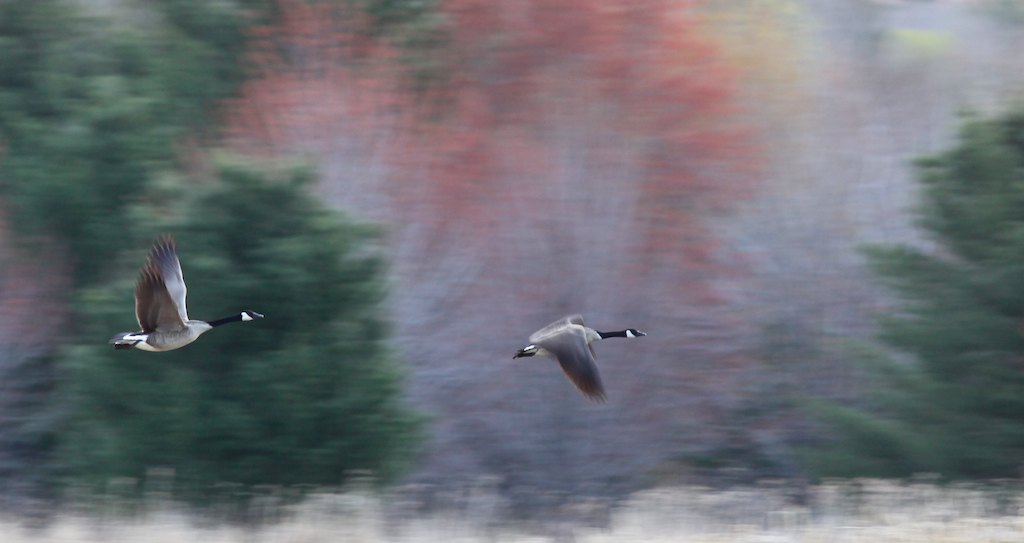
I can't remember ever seeing this much color in the spring...and I don't mean color like the Cow slips, Wood Violets and Tout Lily-but rather the tree color!  I'm sure it's all about the 3 week early spring-temps in the 70s and 80s for a stretch and not really falling off until this week (Mid April).  Aspens nearby have leafed out already and buds and unfolding leaves from other trees are working hard to fully open.  All of which is leaving (ha) the forested landscape here brilliant with reds, oranges and yellows-again, something I never really noticed before at this time of year...to this degree.  For whatever reason, it's beautiful and made the perfect backdrop of these photos of a pair of geese who have set up home just down the road.  I see them about everyday when I'm out and about scouting.  They rise from a nearby pond to the west around 6:00am, then noisily head east to several farm fields to feed (early planted oats seem to be a favorite right now) and I'd imagine soon will set up a nest site.
I was actually really pleased with these shots considering it was a quickly fired series of photographs panning with their flight as they headed out to another field.  I really liked the sharpness of the birds themselves, the light coming through the primaries and blur of the colored background.  You can almost hear their raucous honking as they quickly exit.
Spring was never been my favorite season, but it's growing on me... maybe with global warming, it'll be a bit more enjoyable, although there is something to be said about going through the transition period each year after the snow has melted.  In any regard, I'll just try to always have a camera ready, be out there and appreciate the sights, sounds and colors that surround me.

Tuesday, April 3, 2012

The Hoodies

Hoodie Drake in Full Dress
 This "spring" is flying by so fast, the window of opportunity for photographing waterfowl may be very short I fear.  Although I wouldn't profess to be a wildlife photographer, from time to time I enjoy at least attempting to make pictures of birds and other animals.  Usually a camera of some kind is along while hunting or mountain biking, but photography is second fiddle to the primary activity.    Toting camera gear, can only be done when not carrying a bow or gun or atop fat tires.  For me, it needs to be the primary mission.  Just down the road on a neighbors land, is a swamp and pond and a good location to catch migrating waterfowl and other birds.  Some, like the wood ducks and canadian geese and a pair of sandhill cranes, stay all year here.  Others, like Hooded Mergansers, will be passing through, but spend a while in this small patch of water.
The Chosen One
 This past week gave me the chance to observe and photograph some of their courtship rituals.  I'd never really seen this behavior before-the arched necks, soft croaking call, puffed up crest and several hours of chasing each other around.  When I first saw the female towing two drakes along across the pond, I guessed one would have to put up a good show to leave the winner and mate of the hen.  In between the displaying and chasing, some woodies would cruise in and geese poke along the shore.  A lone crane lit on the far side, so there was always activity in front of the lens.  After a while, the hen seemed to have made her choice, and only one drake was allowed to swim along side her, and any encroachments by the other was met with vigorous pursuit.   Quite an entertaining morning watching it all unfold.
Hoodies and Woodies
 Costly, perhaps....meaning, my final images show a lack of crispness, because of a slow inexpensive lens.  Even in full daylight, I just was hoping for better pictures.  I know photography isn't about equipment, but trying to shoot wildlife does require some special gear-long fast lenses, which equate to smaller wallets!  Shopping for new gear isn't in the cards right now, so I'll have to be happy with, and make the best pictures I can with whatever camera is in my hands.  Of the 200 or so I took, I was fairly happy with these, so they'll  have to satisfy my waterfowl craving  for now.  Soon the birds will move on, and I'll be just as happy with other subjects in front of the camera and I look forward to discovering just what that'll be.
Cruisin Canadians
Mergansers

Monday, March 26, 2012

The Painterly Photos

Canadians in Flight
Interesting accidents sometimes happen, and lately, it seems more often.  I realize, part of it is the equipment I'm using-my 70-300mm lens isn't a fast lens, so it limits crisp images in lower light.  Sometimes, like above, it's okay and I like the end result.  I posted some sandhill cranes a while ago in the same way-panning as they flew by, and holding the shutter down, firing away. 

I like the very "painterly" quality of them-some parts have sharp edges, the rest blurry and with adjusting the color a bit, a nice result can happen.  I'd have to admit, in some ways, these images have become some of my favorite because they are different. 

Canadians Launching
In this image, I liked the ring in the water and the split-second-later tip of the wing hitting the surface, while they flew low over the pond escaping to a corn stubble field nearby.

*  *  *
Female Woodie Landing
I was lucky enough to have beautiful Wood Ducks around all morning and the only early warning one has is the squeal of their call when they are suprised-this female had jumped up on the far side of the swamp and then lit nearby, offering some quick shots.  Although this one doesn't have the impact of the geese pictures, I still liked seeing her head under the wing and the background color reflected in the water.

Woodie Pair
The last couple photographs here are more straight pictures I guess, but when you have birds with such wonderful spring plumage, they almost look made up.  I felt a centered composition for these two worked best.

Female Woodie Cruising
The females of most bird species are almost always drab compared with the males, and wood ducks are no exception, although one could argue that she still is a beautiful bird.  I love the white eye patch and speckled body and bright blue wing bars-as these two swam around, she would make cooing sounds and maybe was in search of a nesting site?

Colors Reflected
The painterly pictures...well, yes, I like a lot, but in looking at the hundreds of images, this one stood out, and it is just a nice crisp photograph.  The colors this overcast morning in the swamp really stood out and I liked the reflections here in the water.  Spring is three weeks early, and leaves are starting to pop out, but most of the vegetation is still bare-surprising me a bit at how much color actually was out there when I saw this.  This location, being rather small, will probably yeild few other waterfowl, but I think I'll try a couple more times and see if I get any more "interesting accidents" coming out of my camera-it can be well worth it.

Saturday, March 24, 2012

Yogi in My Tree

Yogi?
So it's 1:45am and Yogi returns.  Okay, so yeah, it's cool seeing wildlife right out the window, but I also don't want a big bruin like this becoming comfortable setting up camp in the backyard.  He had come out of slumber 2 days ago and raided the bird feeders and I managed to scare him off twice during the night.  Knowing that bears can be a creature of habit, it was in my best interest to take down some of the feeders or keep them out of reach...or so I thought.  I set out a couple game cams as well just in case he should return.   As it turned out, he did and in the process took down a willow limb and somehow, maybe by shaking the tree, got the feeder down that was in the upper branches of the tree.  The feeder is no more-chewed up plastic is all that is left.  So plan B will be to get all the feeders down for a couple weeks and maybe his visits will cease.

It all makes for a good story-life in the country...and this time, a few pictures to go with it.

Tuesday, March 20, 2012

Morning in the Swamp

Sandhills Alight
My favorite time of day is the morning, and one of my favorite places to be witnessing the day wake up is in a marsh or swamp.  Marshes are the lifeblood of the land here-filtering and holding water, and providing a unique place for so much of our native wildlife.  In a way, so much of the outdoor world starts it's day here.

Nearby is a small marsh area with some open water, the perfect place for waterfowl to roost overnight and a hangout for cranes and other birds and animals.  After setting a camo tent up the previous week to photograph some eagles, I decided to just move it down the road and find a concealed place to try my luck here.  Sneaking through the swamp grass in the pre-dawn and brightening sky, already the calls of cranes and nervous cackle of geese could be heard.  Managing to slip into the tent, the tripod was set and camera functions checked.  The small zippered window provided a great view of the water and hopefully wouldn't spook the birds.  Several pairs of geese noisily staked out their claims in different corners of the pond, while a drake wood duck made a quick landing in front of me.

My plan was to be all "professional-photographery" here, ready at an instant to click off award winning images.  It was not the case in the end.  Not wanting to have too much noise, I left the ISO fairly low, which in turn gave me too slow a shutter and blurry photographs of some of my feathered subjects.   Two cranes suddenly launched out from some cattails and quickly I just panned and fired away.  Everything was motion blurred, but the image above grew on me.  It looks like a slapped on Photoshop painterly filter, but in reality it was almost stock with some noise reduction.
Blackbird in Flight
The Red Winged Blackbirds really love this place and it was so loud with the mating calls and warble songs of the males flitting back and forth taking their places in the willows.  When the waterfowl action slowed (the geese had left for nearby fields) the camera found it's way their direction-they can be stunning as well for a common bird.
Hoodies Checking In
As Jim Brandenburg once said, a photographer needs to be ready in an instant, and on more than one occasion, I missed a picture.  This pair of Hooded Merganzers made a dive bomb entry into the marsh over my shoulder and I did manage a few frames as they flew past.  In this shot, I just liked the sun being filtered through the primaries on the wings...just wish I'd had a more interesting background-it needs a secondary subject to liven things up.
Sooo, back to the Black Birds.  It's not terribly exciting, but I did like the tack sharpness of the focus here, which is surprising considering the lens really had to hunt around to lock onto anything in this photograph.  A simple picture, but it holds my interest for a little while.  No worries that it'll end up in National Geographic!

As quickly as the day wakes with a start in the marsh, it also ends....most of the interesting wildlife has moved on to daytime duties and quickly it became much too warm for a mid March day-but that seems to be the theme this year.  I'll return and keep working on that winning (in my mind) photograph here in the swamp, a place with the sights, smells and sounds blend for a perfect start of a day.

Tuesday, March 6, 2012

The Snow Flea Ski


The day started out cold and a skim of new sharp snow on the trail.  From all forecasts it also started out as what would be my final day on skis.  Not that it was a traumatic thing, for I’d only skied five or six times this “winter.”  Yes, if I’d made the effort to drive north, I could have found better snow and spent many more hours on skis than on a fat bike.  But this is my home trail, then one I usually spend equal hours grooming as skiing, but not this year.  We really only had a week of halfway decent snow, before giving way to warm temps and dryness which prevented any semblance of a ski season.

So today was the day for the Snow Flea ski-usually taking place later in March, but temps turning to the fifties this week will end any striding or skating on real snow. The snow Fleas emerge from the buried oak leaf litter below the snow on days pushing into the 30’s and they blanketed the surface of the trail- a sure sign that the end is near.  Normally I’d be on super fast corn snow now with no worry of wax to provide glide.  Not today, that cold morning and a continued light snow, made for no glide conditions, despite a comfortable 30 degrees.  It was a day when even on the down hills, the trail seemed to grab at the bottoms of my skis and force me to break into a skate way before I should…I should be just gliding along instead.  It was decided early on that the ski pace would not be hurried then, that I had no agenda on this day, it was just to ski.

It was work to get from one trail to the next, even at this slow pace and effort and I thought about calling it a day and heading back early.  I decided to keep going, to make the circuit around Levis Mound on snow I’d groomed the previous day, to take advantage of my work.  The high sun on this day had already burned thru some spots, and more hikers than skiers had pounded the base.  Didn’t matter, I could pick my way through, dodge a rock or fallen branch here and there and continue.  I took breaks frequently.  Stopped, took in the smell of the spring forest and tried to spot any movement-deer, wolf, fisher, but nothing was out and about.  The woods were so quiet. 

On the final stretch, I paused again to look up at the towering frosted sides of Levis Mound.  On the east side, the sun had yet to claw it’s way into the snow cover and it still had that mid winter look.  I’d wished I’d seen that more this year.  Only skiers really understand the anticipation of ski season, of waiting months for that first round of softly falling flakes, of the first grooming and first glide down the fresh corduroy.  For me, this winter never went far beyond that anticipation.  At that moment, the lonesome whistle of the train headed from Black River to Merrillan echoed miles away and for whatever reason struck me as the signal that for this year, my time on skis, on this trail, were over.  The Snow Fleas, the unseen animals, would have the trail to themselves again.

Sunday, March 4, 2012

The First...Sweaty Yeti

Riding a race bike is an art - a thing that you do because you feel something inside.  -Valentino Rossi
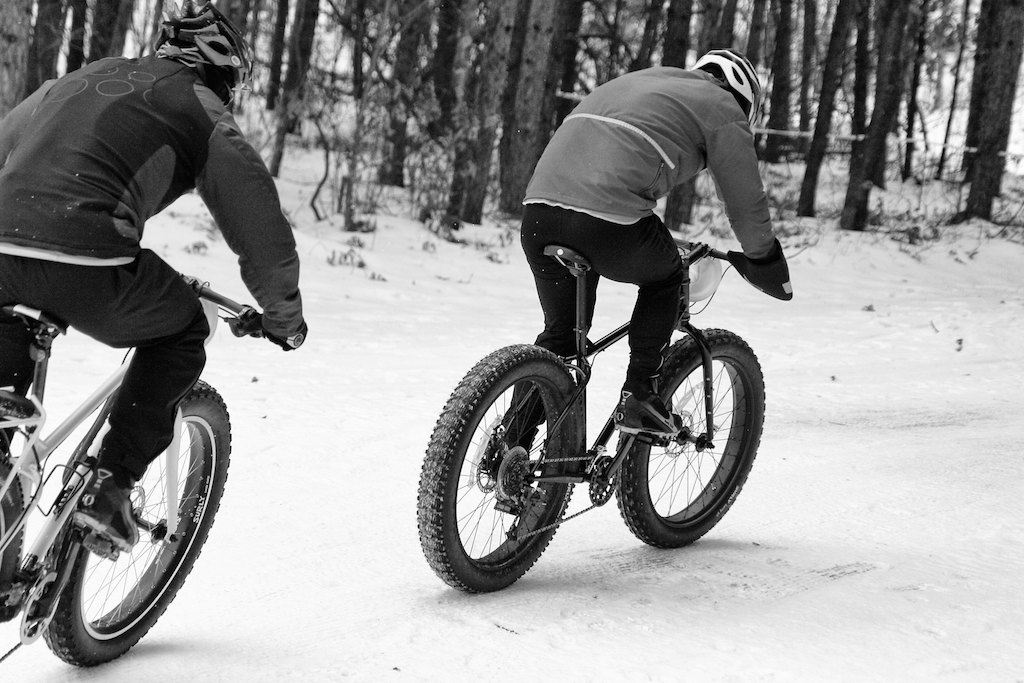
Randy & Chris Hot Lapping
I had decided a few years ago never to run a race again.  After 14 years of being the race director of the Buzzard Buster mountain bike race, and with no one getting seriously hurt or killed... or sued-it was time to retire.   Figured I should count my blessings and call it a career.  Then...these fat bikes slowly appear on the scene and a whole different "race" mentality comes along.  The fun factor was back in full force and it was clear it'd be the only way I'd step back into that race directors chair. It had to be that kind of fun with sans the seriousness.

The race is On
The concept of racing (these new) fat bikes...in winter, on snow, is in itself a insanely fun idea.  Conditions could be anything-bitter cold, deep sloggy snow or a perfect softly falling snowflake rock hard race course day-like we had. The plan was hatched this past fall at Gnomefest, realizing that at Levis Mound we had the perfect venue to run this kind of event.  A warm chalet, singletrack and ski trail and start field right out the door and if conditions changed, the equipment to handle it if needed.  Fat-Bike guru Gomez had set a standard of pioneering snowbike races to the south, with bike sharing and a team format (not many own a fatbike!) Besides, it was an opportunity to show off the trail a little to anyone who maybe hadn't been to Levis before. 

Fatty Lumpkin's Wheels making the Rounds
  At the starting line (for the Le Mans start) there's quite a mixed bag of racers from rail thin super fit  to others who just love to ride with a couple friends all day (or who are recruited last minute to form a team).  There is a fair amount of pre-race joking, deciding who's bike to use or team to join draft style and "hydrating" by racers and spectators alike (which numbered about the same). There would be some serious pedal crunching by the elites, but the enjoyment of the ride would not be lost for anyone during the next three hours.  


I do like this bunch of people.  They are the friendliest of folks to be around and any pretentiousness that one might have to wade through in other racing, is not to be found here... or in them.  I raced for a long time- ski and mountain bike, and made many friendships along the way.  But in the past year or so, while attending Gnomefest and now this fat bike scene I'm enjoying this side as well.  It's introduced me to a whole new group of people that aren't afraid to ride hard, then sit down and share a few beers and talk bikes, where they're from, and what we share a passion for.  In this inaugural Sweaty Yeti, I got sucked in by them and switched from a directors hat to pull on a helmet to give it a go.  The years of racing were buried inside somewhere, and though I tired my best, the lack of fitness made the laps hurt!  No matter, I rode within myself on the later laps, enjoyed the ride and knew the post race would be worth it.


In the end, the victors were crowned (with some sweet funky hats) and the "Most Fun Team" awarded, and prizes to just about everyone else, thanks to Sand Creek Brewery and our other sponsors.  The riders seemed to think the day went well, was fun and were appreciative. I guess that's all a race director can ask for.   The Yeti raised funds for the trail and maybe real grooming equipment down the road (I don't think this is a fad). Some riders headed out while others stayed to hang out around the fire long into the night. The snow then kicked up a notch as to signal a good ending to the day with good people and I could only agree.


Smith: Tracking surveys remain critical part of DNR's gray wolf population estimate in Wisconsin

  Smith: Tracking surveys remain critical part of DNR's gray wolf population estimate in Wisconsin Tracking surveys by DN...