|
| Dick Thiel-Field Study |
The
first law of ecology is that everything is related to everything
else.-Barry Commoner
If
anything was learned at a recent TWIN wolf ecology workshop, it was
that-everything is connected-Including... the role of
the wolf in our environment. TWIN (Timber Wolf Information Network)
is based in Central Wisconsin, and focuses on science-based
educational outreach, conveyed through wolf ecology workshops
presented each winter. The session I attended was held at the Beaver
Creek Nature Preserve near Fall Creek.
The
workshop was a great learning experience for anyone interested in
this species. TWIN instructors Scott and Dick Thiel and Beverly
Paulan did an excellent job in presenting information in a very
scientific and factual way. Attendees varied in background from very
pro-wolf to those of us who are trackers and want to delve deeper
into what this creature is about and its place in our natural world.
In
presenting the historical view, Wisconsin was a much different place
and supported many more species in the past. Woodland caribou
(extirpated
by 1910),
American Bison (1832), Elk (1868), Cougar, Lynx and Wolverine, all
were common here. Of course bear, wolves and deer also inhabited the
state, which was composed of oak savannah (prairie) in the south-west
half and boreal forest and hardwoods in the north.
To
understand the wolf now, we have to comprehend its past. By 1900,
Wisconsin was in the midst of ecological devastation. Europeans
moving into the Upper Midwest wiped out the white pine at first
followed by the remaining timber. Expanding towns and cities along
with farming changed forever the landscape of the state. Market
hunting eliminated entire species and any animal deemed as direct
completion to man were persecuted. Bounties were placed on most
predators including the Grey Wolf, which was successfully erased as a
species here by the 1950s. Ecologically, it was not understood at
the time what role large predators have in maintaining a healthy
ecosystem. Frontier mythology and tall tales also played into this
extirpation.

In
trying to fathom the wolf in context of modern culture, TWIN member
Scott Thiel also included an extensive natural history component in
its workshop. Although I'm familiar with a basic knowledge of large
carnivores, including wolves, the presentation dove deeply into
where they evolved from, their genetic make up, and how climate
changes forced animals to develop differently depending on where they
lived and migrated. A robust species, the Dire wolf, once roamed
much of North America and became extinct around 10,000 ago. Other
canis family members still remain, though some are truly threatened
or endangered. Coyotes are very common and thriving, while the Grey
Wolf (Timber Wolf) has gained foot holds were humans have allowed it
to do so. Lycaon (Eastern Wolf) survives only in Algonquin
Provincial park in Canada, while very small numbers of Red and
Mexican Wolf attempt a comeback in North Carolina and Arizona
respectively. There seems little optimism either of those species
will successfully recover.
Biologically,
the wolf is designed to be effect at taking down ungulates (hoofed
animals) with whitetail deer being the primary prey in
Wisconsin-though beaver can also comprise a significant food source.
Success of the species relies heavily of it's unique social
configuration, unique among all large predators. Jodi Picoult
perhaps describes it best: “I
woke up one morning thinking about wolves and realized that wolf
packs function as families. Everyone has a role, and if you act
within the parameters of your role, the whole pack succeeds, and when
that falls apart, so does the pack.”

The
family structure, or pack, typically is made up of 2 or more animals,
with 3-4 being the average in Wisconsin. There is a strict
hierarchy- the alpha pair, another related adult or 2 and any
surviving pups the most common group. The average lifespan is 2.2
years old (if one includes pups) or 4-8 not factoring in the high
mortality of young of the year. Starvation is the leading cause of
death for pups who are born in May. In summer, young are moved to
rendezvous sites and by fall they accompany the pack. Wolves in
Wisconsin average a 25% mortality rate each year.
“The
strength of the pack is the wolf and the strength of the wolf is the
pack.” -Rudyard Kipling
Territories
average about six by six miles in Wisconsin. A pack's home turf is
based on the type of prey, its abundance and weather. Typically,
range and pack size are much larger to the west and north where prey
is larger. As with humans, pack territories are defended against
outsiders-a “fence” of scent (scat and urination) delineates
boundaries and wolves, with a hyper sense of smell, respect each
packs home. Besides communicating with smell-howling can also define
a territory and aids in communication between pack members.
Of
all the information I learned, the accuracy of the Wisconsin
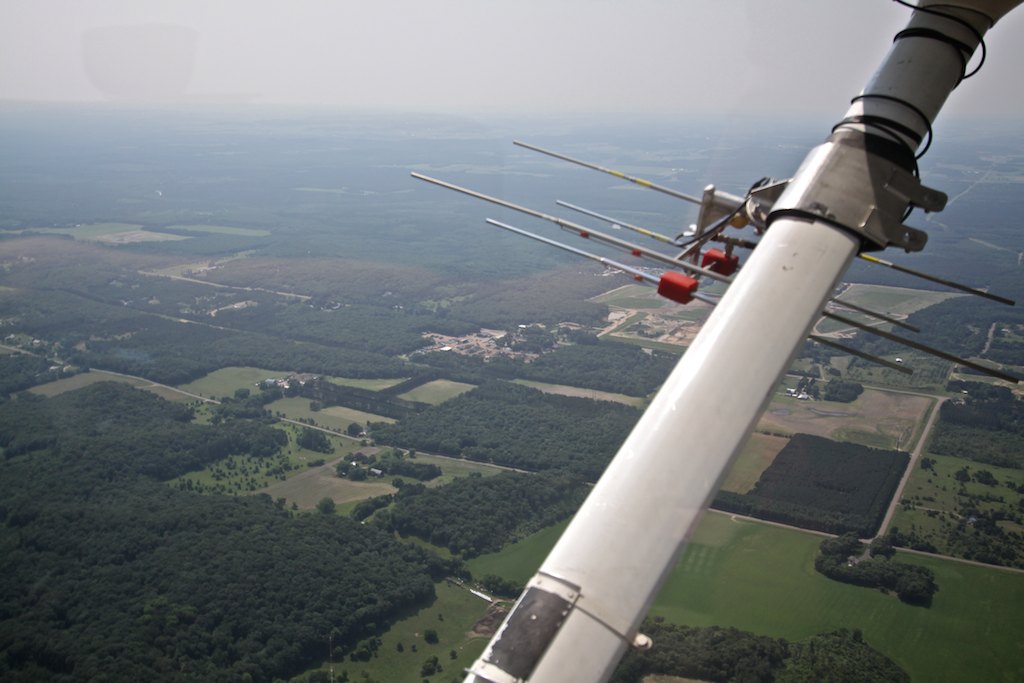
monitoring program is most remarkable. Paulan, a DNR pilot,
presented information on how the DNR conducts surveys to formulate
rigorous population numbers. Despite barroom banter, there are not
wolves behind ever tree. Wisconsin conducts the longest running and
most detailed analysis in the country. Between monitoring radio
collared animals and tracking surveys, an accurate assessment can be
made of distribution, pack and territory size, birth and mortality
rates and total numbers. Wisconsin is the only state to conduct
annual surveys over the entire wolf range and do aerial monitoring
across all management blocks. Wolves travel great distances daily,
so tracks and other sign left behind can give the appearance of
greater than actual numbers. Detailed scrutiny of survey results
yields scientific figures aiding research and management of human
wolf conflict.
Each
wolf ecology class also includes field work. Several TWIN members
spent the morning surveying the adjacent Eau Claire county forest for
wolf and other carnivore sign. Luckily, a lightly traveled snow
covered woods road provided the perfect teaching opportunity for the
students. We caravanned to the remote location and within a short
hike studied tracks of fox, coyote, fisher and wolf. The beauty of
this location was many of the tracks were next to each other, so size
and gait could easily be compared between species. A RLU (raised leg
urination) also marked this stretch of road, indicating an alpha wolf
had ventured here. Forest type and regeneration were also discussed
and how land practices effect animals living there.
“The
wolf made the deer what it is. The deer made the wolf what it is”
For the Timber wolf in Wisconsin, the whitetail is the main prey. In
presenting predator/prey associations, Dick Thiel examined closely
that relationship and how it effects the ecosystem. Studies
unequivocally show wolves prey mostly on the young and old- much
different from (human) hunters who tend to kill the most prime
animals. The end result is that the prey species can actually be
healthier as a result by wolf predation. Contrary to most tailgate
chatter, the wolf, at a density of .1/square mile (compared to
coyotes at 1/sq.mi or bear at .5/sq.mi) are far down the list as a
cause of deer mortality. Hunters and winters top the list by a huge
margin. Recent scientific studies of deer mortality conducted in
Wisconsin and the Upper Peninsula of Michigan support this fact. In
earlier times, nature would keep the deer herd in check with
predators, avoiding over browsing and changes to the ecosystem. Now,
man has stepped in to dictate deer numbers (as a favored species) and
carnivores like the wolf are secondary.
The
wolf is neither man's competitor nor his enemy. He is a fellow
creature with whom the earth must be shared. ... If the wolf is to
survive, the wolf haters must be outnumbered. They must be
outshouted, out financed, and out voted. Their narrow and biased
attitude must be outweighed by an attitude based on an understanding
of natural processes. (Dr. L. David Mech)
Of
course wolf/human conflicts do occur acknowledged the TWIN
presenters. Whereas “predation” is killing of a native prey,
“depredations” are of a domestic animal, and they do happen.
Proponents of the Wisconsin wolf hunt justified it because, among
other reasons, agricultural damage (to livestock). Statistically in
the state, only .17% of the farms experience loss. Interestingly,
deer damage payments total $1.2 million in ag claims, bear at
$262,000 and $151,000 for wolves, ( $56,000 of that paid to hound
hunters). Wolves depredating on livestock (much like problem bears)
are targeted though lethal and non lethal means and have been quite
successful in reducing those losses. Depredation on hounds has not,
and even though the DNR reports on every dog killed and publishes
“caution areas” there are still claims being made and paid by the
state-in some circles, a controversial policy. No other state makes
(up to $2500) payments to hound hunters. 2/3rds of these losses
occur during the bear (hound) training season in July and August when
wolf packs move to rendezvous sites, which are diligently protected.
Although the wolf hunt law provided for the very contentious use of
dogs, past seasons never progressed into the mating and breeding
seasons-a potential for more aggressive behavior.

Although
Little Red Riding Hood in reality has a much more perverse meaning,
tales like that of the big bad wolf along with the Three Little Pigs
and folklore perpetuate an animosity not founded in reality. Prior
to 1900, there were few attacks in North America and until 2005, no
humans killed. (2005-a
runner in Saskatchewan
near a dump was killed, bear and wolf possible and not confirmed. In
2010 a female runner in Alaska, also near a dump and not taking
precautions was killed) Other
species, like our much more common Black Bear, (which does
attack and kill people) seem to get a free pass and not generate the
same felicitous fear the wolf does. I queried why that might be?
Scott Thiel suggested maybe because wolves are similar to us and
perhaps we see ourselves in wolves.
Farley
Mowat (Never
Cry Wolf)
described it this way: “We
have doomed the wolf not for what it is, but for what we deliberately
and mistakenly perceive it to be –the mythologized epitome of a
savage ruthless killer – which is, in reality, no more than a
reflected image of ourself.” And
author Gerald Hausman concurs with Thiels thought:
“We humans fear the beast within the wolf because we do not
understand the beast within ourselves.”
We learned there is
a correlation between our two species. Both have been evolutionarily
successful, both live in social groups made up of families and are
characterized by hierarchies, cooperation and communication. We both
have fixed territories and homes, pursue and consume flesh while
hunting the same species. We have co-evolved with wolves.
At the time our
hunter/gatherer ancestors, we lived in a boom or bust cycle of
survival. We had large territories and the spiritual view of nature
was positive. Later, during our agriculture based society, we had a
stable food supply for the most part and a religious view of nature
in the negative. The natural world was to be conquered and tamed.
Market hunting exploited game and sport hunting developed to conserve
just a selected species with the elimination of a suite of predators
who were viewed as competition. Perhaps this backstory shapes our
view of the wolf?

The TWIN workshop wrapped
up with a close look at wolf management across the country and more
specifically the state. 1974-75 marked the first wolves wandering
back into north west Wisconsin from Minnesota. By 1977-78, 2 packs
had formed in Douglas County, signaling a start in recovery to the
state. That same year the species was listed as threatened in
neighboring Minnesota, while endangered elsewhere. In 1999,
Wisconsin's written wolf recovery plan had a goal of 350-500 in
population in what was thought at the time to be suitable wolf range.
They have proven to be able to adapt to habitat outside of the deep
remote forest of far northern Wisconsin and populations have now
reached 660 (in last winters count).
Federal
protection yo-yo'd back and forth for a number of years before
delisting in 2012. Although no mention of a wolf hunting season was
contained in the original wolf recovery plan, a harvest bill was
quickly written after de-listing. Dick Thiel recalled that January
29th,
2012 was a Friday night ( date of the wolf de-listing), by Saturday a
hunt bill was drafted and the following Wednesday there were public
hearings. Quickly thereafter the bill was signed into law. Of
concern with Wisconsin Act 169 (wolf hunt bill) was how quickly it
was enacted. All indications are it was written and backed by a
special interest group and passed long by legislators. Concerns
raised were that the DNR had no negotiations with native tribes, to
reduce the population to 350, having a season structure spanning
one-third of the year-including breeding season and the unprecedented
use of hounds. In one hastily passed bill, science plans were
totally wiped out by the legislature.
After three years of sport
hunting, the eastern grey wolf was again re-listed in December of
2014. How federal law protections of wolves and indeed the future
of the Endangered Species Act are uncertain. Lawmakers, even at this
time, are rushing to pass legislation to remove all protections
permanently (as they have in Montana and Idaho). The controversy
over this animal will undoubtedly continue. There are extreme views
from stakeholders on both sides of the wolf issue and perhaps groups
like TWIN, and the scientific education they provide, can narrow that
divide and bring a more sound reasoning and understanding of the
species.
Wolves
are not our brothers; they are not our subordinates, either. They are
another nation, caught up just like us in the complex web of time and
life. (Henry Beston)